

You've probably noticed hyaluronic acid in your own skin care products. It's a naturally occurring molecule that keeps our joints, skin, eyes, etc. hydrated and functioning!
It turns out the same molecule does the same job for your dog.
That's why we put this super ingredient in our HydroClear™ line. To keep your pet, not just clean, but hydrated too!
What is hyaluronic acid?
Hyaluronic acid is a naturally occurring, moisture-binding molecule found in tissues throughout the body, yours and your dog's and your cat's alike. It's already in skin, joints and eyes, doing the job of holding water where the body needs it.
Skin is where most of it lives. A 2012 review in Dermato-Endocrinology by Papakonstantinou, Roth and Karakiulakis puts about half of the body's total hyaluronic acid in the skin, and describes skin hydration as depending on the water it holds there.
Despite the name, it isn't an acid in the way people usually mean it. There's nothing exfoliating or harsh about it.
You'll often see the claim that it holds up to 1,000 times its own weight in water. That number is less settled than the marketing makes it sound. When University of California chemists Scott Borchers and Michael Pirrung tested it in a 2024 study in the Journal of Cosmetic Science, a dilute hyaluronic acid solution behaved much like plain water, and they traced the famous figure back to older research that had been misread. The water-holding is real. The exact multiplier is up for debate.
What matters on skin is simpler: applied topically, it binds water molecules and draws in moisture, which is what delivers hydration quickly and where it's needed.
It's also biocompatible, which means the body recognizes it rather than treating it as something foreign and reacting to it. That's the part that makes it usable on skin that doesn't tolerate much.
Does hyaluronic acid work for dogs and cats?
Yes, and for the same reason it works on human skin.
Dogs and cats produce hyaluronic acid naturally, in the same tissues we do. It isn't a species-specific ingredient that has to be adapted, and it isn't a trend borrowed from human skin care that happens not to translate. The molecule is the same one, so it does the same job.
What it does when applied topically:
Hydrates fast. It binds water and pulls moisture in, so it works quickly rather than needing to build up over weeks.
Soothes dryness. Dry, flaky skin and a dull-looking coat can be a moisture issue, and this is the ingredient that addresses moisture directly. Plenty of other things can cause both, which is worth keeping in mind.
Supports the skin's resilience with regular use, which is a slower benefit than the hydration but the one that matters over months.
Stays gentle. It doesn't sting and it doesn't strip, which is why it can be used daily and on the parts of your pet you'd normally be nervous about touching.
That last point is what makes it useful rather than just pleasant. Plenty of ingredients hydrate. Very few are gentle enough to use around an eye.
How does hyaluronic acid compare to aloe, oils and oatmeal?
They aren't really competing, they're doing different jobs. Hyaluronic acid pulls moisture in, oils seal it, aloe and oatmeal soothe, and sulfates clean. Knowing which is which makes label-reading a lot faster.
| Ingredient | Main job | Good to know |
|---|---|---|
| Hyaluronic acid | Hydrates (draws water in) | Biocompatible and gentle enough for faces and around eyes |
| Aloe | Soothes and cools | Brings some hydration too, and pairs well with hyaluronic acid |
| Oils (coconut, avocado, jojoba) | Seal moisture in | Heavier, and can feel greasy on a long or double coat |
| Oatmeal | Calms | A classic soothing agent, more calming than hydrating |
| Sulfates | Clean (make shampoo lather) | Effective, but can take some of the skin's natural oils with them |
Oil seals moisture in while hyaluronic acid brings moisture in, so they're two halves of the same problem. And sulfates are a fair trade on a muddy dog and less so on a sensitive one.
So it isn't HA versus aloe versus oils. It's whether the product you're holding hydrates, seals, soothes or cleans, and whether it does the one you actually need.
Where can you use hyaluronic acid on your pet?
Anywhere you want hydration without irritation. The gentleness opens up places most products can't go.
Faces and around the eyes. This is where you most want something non-irritating and least want anything harsh.
Ears and noses. Same logic applies, and they're worth cleaning regularly even though it's awkward.
Paws and skin folds. They pick up the most and they dry out the fastest.
Post-bath and post-swim. Bathing and chlorinated or salt water both pull moisture out. A hydrating step afterwards is an easy thing to add and an easy thing to forget.
Daily maintenance on sensitive skin. If your pet doesn't tolerate much, non-medicated and biocompatible is a sensible place to start.
Which Skout's Honor products use hyaluronic acid?
HydroClear™ is our hyaluronic acid technology, and it shows up in three products, all non-medicated.
HydroClear™ Eye Wash is a gentle, non-medicated solution that cleanses and refreshes your pet's eyes and the surrounding area. It flushes out gunk, debris, allergens and post-swim irritation, helps reduce the appearance of tear stains, and keeps eyes clear, clean and comfortable. Sting-free, and safe for daily use on dogs and cats.
HydroClear™ Eye, Ear & Nose Wipes are built for the sensitive areas specifically. Wipe the nose, clean in the ears, and remove the appearance of tear stains around the eyes. Fragrance-free, non-medicated and sting-free, on plant-based FSC-certified fibers.
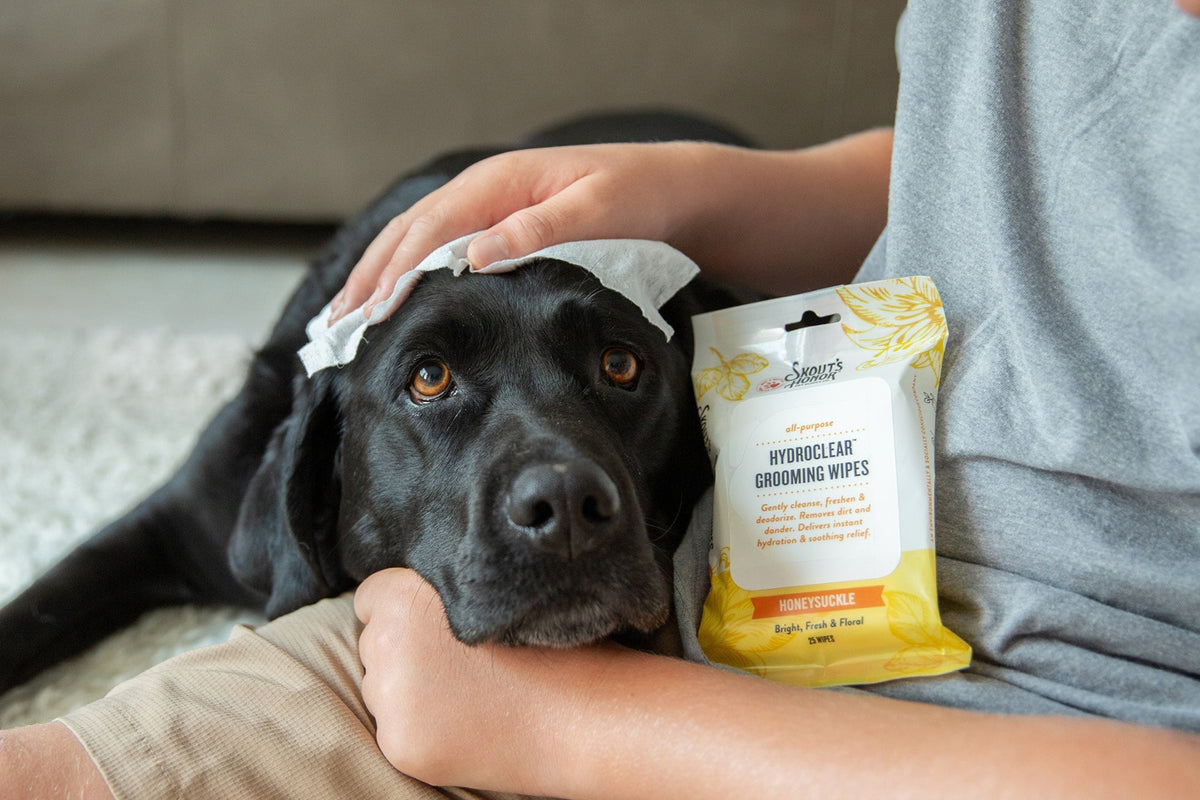
HydroClear™ Grooming Wipes are the everyday ones, for faces, paws, skin folds and, yes, back ends. They remove dirt, dander and odor while delivering rapid hydration. Available fragrance-free for sensitive skin or in Honeysuckle if you want the bright, fresh, floral version.
Everything is cruelty-free, vegan and made in the USA. The whole lineup lives in the HydroClear™ collection, and there's a bundle if you want the set.
When should you reach for a hyaluronic acid product?
Mostly as everyday upkeep, rather than something you save for a problem.
Daily, on the face. A quick wipe of eyes, ears and nose is thirty seconds and it stops the gradual buildup that becomes a project.
After a bath or a swim. Rehydrate rather than leaving the coat to recover on its own.
On sensitive skin. Non-medicated and biocompatible is a good default when most things are too much.
Between grooming appointments. Wipes cover a lot of ground when a full bath isn't happening.
As part of a normal routine. Everyday hydration, alongside whatever else you already do.
For more on the wellness side of the range, our pet wellness page covers the rest.
When should you see your vet instead?
This matters more here than in most of what we write, because eyes are not a place to experiment.
A cleansing wash is a grooming product. It is not treatment, and it isn't a substitute for a diagnosis.
Go now, not tomorrow, if you see any of these:
- An injury to the eye, or anything stuck in it
- Chemical splash of any kind, including shampoo
- An eye that looks bulging or larger than the other one, or swelling around the lid
- Sudden trouble seeing, bumping into things, or pupils that look uneven
- Squinting or an eye held shut, especially with redness
Call your vet today for:
- Yellow or green discharge, or discharge that's suddenly much heavier
- Cloudiness, or any visible change to the surface of the eye
- Pawing or rubbing at one eye
- Sensitivity to light
- Any sudden change in one eye and not the other
Eye problems can move quickly, and a few of them have a genuinely short window. If something looks wrong rather than just messy, that's a phone call, not a wipe.
Same principle for skin. Persistent dryness, hair loss, open sores, a foul smell, bleeding, or irritation that keeps coming back all deserve a proper look rather than a hydrating routine.
What's the bottom line on hyaluronic acid for pets?
Hyaluronic acid is a moisture-binding molecule your pet already makes, it pulls water into the skin, and it's gentle enough to use daily on the areas you'd otherwise leave alone. Most ingredients are one or the other, which is why this one ended up in everything.
Frequently asked questions
Does hyaluronic acid work for dogs?
Yes. Dogs produce hyaluronic acid naturally in their skin, joints and eyes, so it's the same molecule doing the same job rather than a human ingredient being adapted. Applied topically it binds water and draws moisture into the skin, hydrating quickly, and it's gentle enough for daily use on sensitive areas.
Is hyaluronic acid safe for pets?
It's biocompatible, meaning the body recognizes it rather than reacting to it, and it's non-irritating and sting-free. Our HydroClear™ products are non-medicated and safe for daily use on dogs and cats. As with any product, stop if you see a reaction and talk to your vet.
What does hyaluronic acid do for a dog's skin?
It hydrates. It binds water molecules and draws moisture in, which helps with dryness and a dull-looking coat, and with regular use it supports the skin's resilience. It doesn't clean, seal or exfoliate, so it works alongside the other things in a routine rather than replacing them.
Is hyaluronic acid the same as an exfoliating acid?
No, and the name misleads people. Exfoliating acids like glycolic or salicylic remove dead surface cells. Hyaluronic acid does nothing of the kind. It's a humectant, so it holds water, and it's one of the gentlest hydrating ingredients available.
Hyaluronic acid or coconut oil for my dog?
They do opposite halves of the job. Oils largely sit on the surface and slow moisture escaping, while hyaluronic acid is a humectant that draws moisture in. Oil can also feel heavy on a long or double coat. If you want hydration, that's hyaluronic acid. If you want to seal it in, that's an oil.
Can I use my own hyaluronic acid serum on my dog?
Better not to. The molecule is the same, but human formulas often include fragrance, alcohol, preservatives or active ingredients that aren't intended for pets, and anything near a mouth is likely to be licked. Use a product formulated for pets.
Will it get rid of my dog's tear stains?
Our Eye Wash and Eye, Ear & Nose Wipes help reduce the appearance of tear stains as part of regular cleaning. What they can't do is address why the tearing is happening. Persistent or heavy tearing in one eye is worth a vet visit, since it can point to something that needs attention.
How often can I use HydroClear™ products?
Daily. They're non-medicated and formulated for daily use on dogs and cats, which is really the point of a gentle hydrating product rather than a treatment.
Dog Eye Wash vs. Saline vs. Eye Drops: Which Pet Eye Wash Is Right for Your Pet?