
Summary
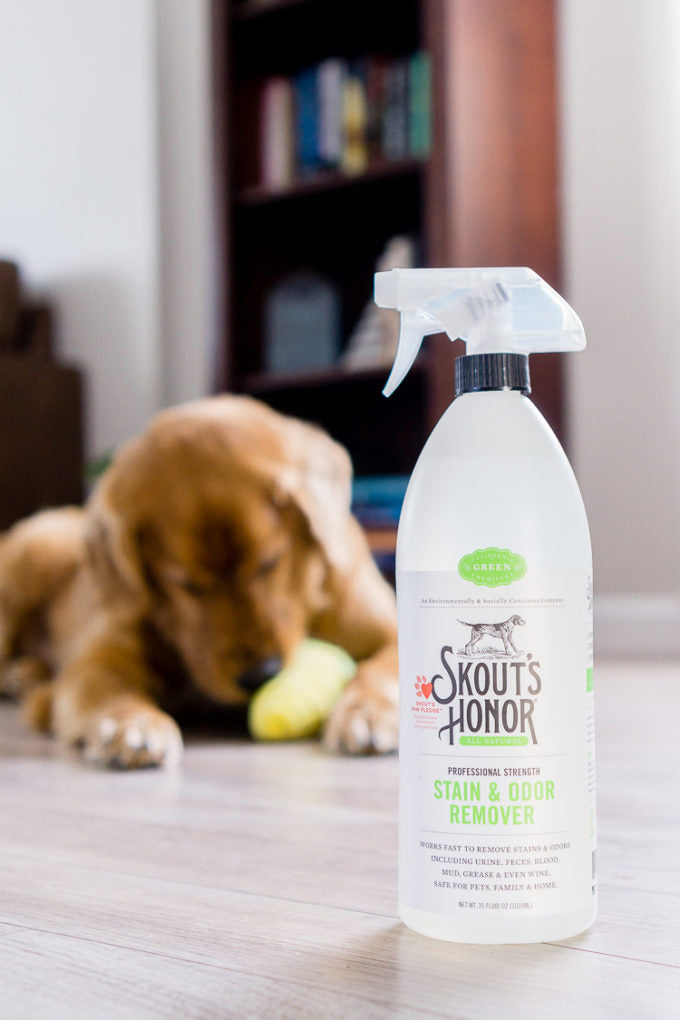
A pet mess is really two separate jobs that happen to arrive in the same package. To remove both at the same time, use a non-enzymatic cleaner like Skout's Honor Stain and Odor Remover that will tackle both the odor causing compounds and the stain proteins. Removing the whole stain, not just covering it up, without needing any pre-treatments.
Why does the stain come out but the smell come back?
Because the thing you can see and the thing you can smell are not the same material. Removing one does not remove the other, so a product has to do both jobs. That gap between "looks fine" and "smells fine" confuses almost everyone, and it isn't a sign you did a bad job. It's a sign you solved one of two problems.
The stain is the visible part. Pigments, proteins and residue sitting in and around the fibers of whatever it landed on. This is the part you can see, so it's the part you attack, and it's the part most products are built to handle.
The odor is a different set of compounds entirely, and they behave nothing like the stain. Some of them are volatile, meaning they lift off into the air, which is why a room can smell before you've found the spot. Others are barely soluble in water, so they dry into a residue that grips the fibers and stays put through ordinary cleaning.
The clearest documented version of this comes from skunk chemistry, which is an extreme case of an everyday problem. Writing for the University of Bristol's Molecule of the Month in February 2022, chemist Simon Cotton explains that alongside the thiols that make skunk spray so unbearable, the spray also carries thioacetates. Those "are less smelly than the thiols, but do slowly get hydrolysed by water, releasing the nauseating thiols." Which is why a dog that seemed fine can smell skunky again days later, after getting wet. The odor was never removed. It was just quiet.
That is the whole problem in one sentence. Something can look clean, smell clean, and still be holding the material that will smell again on the first damp day. So here's how to handle both halves, whatever the mess was and whatever it landed on.
Why don't most pet stain removers get rid of the smell?
Because most of them are built for the stain and treat the odor as an afterthought. There are three common approaches, and each one runs out of road somewhere.
Soap and water lifts surface residue and dilutes what's left. On a fresh, minor mess that's often enough. On anything that's soaked in, you're mostly moving the problem around and adding moisture, which can spread the stain wider than it started.
Fragranced sprays put a scent on top of an odor. It works for an afternoon. Nothing has been removed, so when the fragrance fades you're back where you started, now with two smells instead of one. This is why our stain and odor formulas are fragrance-free: there's no perfume doing the work, so there's nothing to wear off.
Enzyme cleaners are the category default and they're not snake oil. Enzymes speed up the breakdown of organic matter, which is genuinely the stain, and under the right conditions they do it well. The catch is that they need those conditions: real dwell time, a surface that stays damp, a moderate temperature, and a bottle that hasn't lost activity sitting under your sink. They're also not built to neutralize the odor compounds, which is the other half of the job. We went through all of this properly in why enzyme cleaners don't always work.
What does Skout's Honor use instead of enzymes?
Two technologies doing two different jobs: Bio-Kore® for the stain, Molecular Deodorizer for the odor. Neither one is alive, so neither one needs conditions to work.
Bio-Kore® handles the stain. It's our proprietary plant-based surfactant technology, a surface tension reducer that helps lift a mess away from the material it's stuck to. Its exceptionally small molecules surround and begin breaking down the stain while separating it from the surface, making it easier to remove.
Unlike enzyme cleaners, Bio-Kore® doesn't rely on living ingredients to work. That means there's no pretreatment or carefully timed dwell period, it remains stable through extreme temperatures, never expires, and can still tackle a stain even if another cleaner was used first.
Molecular Deodorizer goes after the odor compounds. It's mineral-based, and it reacts with odor-causing compounds like sulfur and nitrogen dioxide on contact, neutralizing the building blocks of a foul odor. It works instantly on both airborne and surface odors, it stays effective in all conditions, and it never expires either.
They're biodegradable and bio-renewable, they're made without harsh chemicals, and they were developed under the California Green Chemistry Initiative standards. Safe for pets, family and home when used as directed. There's more on the whole approach on our plant-based cleaning page.
Our teardown: what each approach needs before it works
Most comparisons stop at "enzyme-free" and leave it there. Here's the version we'd want if we were the ones shopping. Every row below is a condition the product needs met before it can do anything, which is the part that decides whether a cleanup works on a Tuesday night in a real house.
| What it needs to work | Typical enzyme cleaner | Bio-Kore® + Molecular Deodorizer |
|---|---|---|
| A timed dwell period | Yes, often 10 minutes to several hours | No. About 5 minutes on a fresh mess |
| The surface to stay damp while it works | Yes. Enzymes only act in solution | No |
| A moderate temperature | Yes. Activity drops outside the optimal range | No. Stable through extreme temperatures |
| A bottle that hasn't lost potency | Yes. Biological activity declines over time | No. Never expires |
| To be the first thing applied | Usually. Prior cleaner residue can deactivate enzymes | No. Works even if something else was tried first |
| A separate step for the odor compounds | Yes. Enzymes break down organic matter, not odor compounds | No. Molecular Deodorizer is in the bottle |
None of that makes enzymes bad chemistry. It makes them conditional chemistry. Our position is that a cleanup at 11pm on a carpet you can't keep damp is the normal case, not the edge case, and the product should be built for that.
What are the three rules for removing pet stains and odor?
Saturate rather than mist, extract rather than blot, and never add heat. When a cleanup doesn't work, the problem is usually technique rather than the cleaner itself.
- On anything absorbent, saturate rather than mist. Whatever spilled soaked in to a certain depth, and your cleaner has to reach the same depth. On carpet, liquid spreads out in a cone underneath, so the mess is always wider below than it looks on top. Treat a generous perimeter around what you can see. This one is for carpet, upholstery, mattresses, concrete and turf. On wood, laminate and anything with seams, do the opposite and keep the liquid to a minimum.
- Extract, don't just blot. Blotting lifts some of the loosened material and leaves the rest sitting there. Getting it physically out of the surface is what finishes the job, and on carpet that means a wet/dry vacuum rather than a stack of paper towels. This is the step most instructions skip and it's the one that decides whether the smell comes back.
- Don't add heat. No steam cleaner, no hot water, not on protein messes and especially not on urine. This is not folklore. Marlene Geiger of Iowa State University Extension and Outreach AnswerLine puts it plainly: "Protein stains will set if exposed to hot water, an iron, or a dryer. Heat cooks the protein, causing coagulation between the fibers in the yarns of the fabric, making the stains more difficult to remove." Her list of protein stains includes blood, sweat, grass, mud and most dirt, which covers a large share of what a dog brings home.
How do you treat each type of dog mess?
The three rules hold across all of them, but the chemistry changes, and so does which formula to reach for.
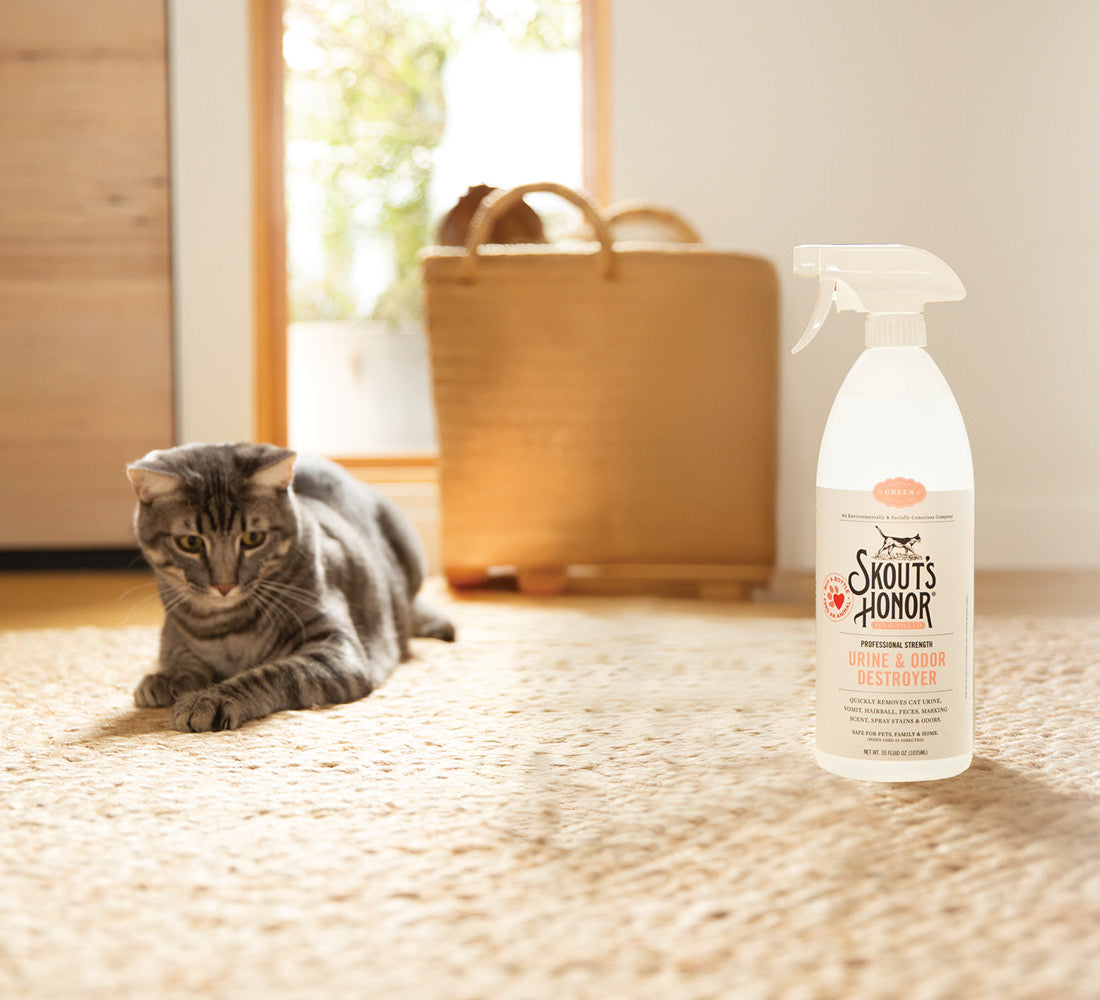
Urine. The hardest of the common ones, because the odor compounds outlast the stain by a wide margin. Urine also travels further than anything else, straight through carpet into the backing and the pad. Use Urine Destroyer, which is built for it, and saturate well past the visible edge. Cat urine is its own chemistry and gets Cat Urine & Odor Destroyer, spray and marking included. If a urine smell keeps coming back after a thorough job, that's a specific problem with a specific answer, and the dog urine smell that won't go away covers it.
Feces. Remove the solids first, and resist the urge to scrub, which pushes the residue deeper into the fibers. Then treat it like any protein mess with Stain & Odor Remover. Diarrhea soaks in fast and far, so treat a wider area than feels necessary.
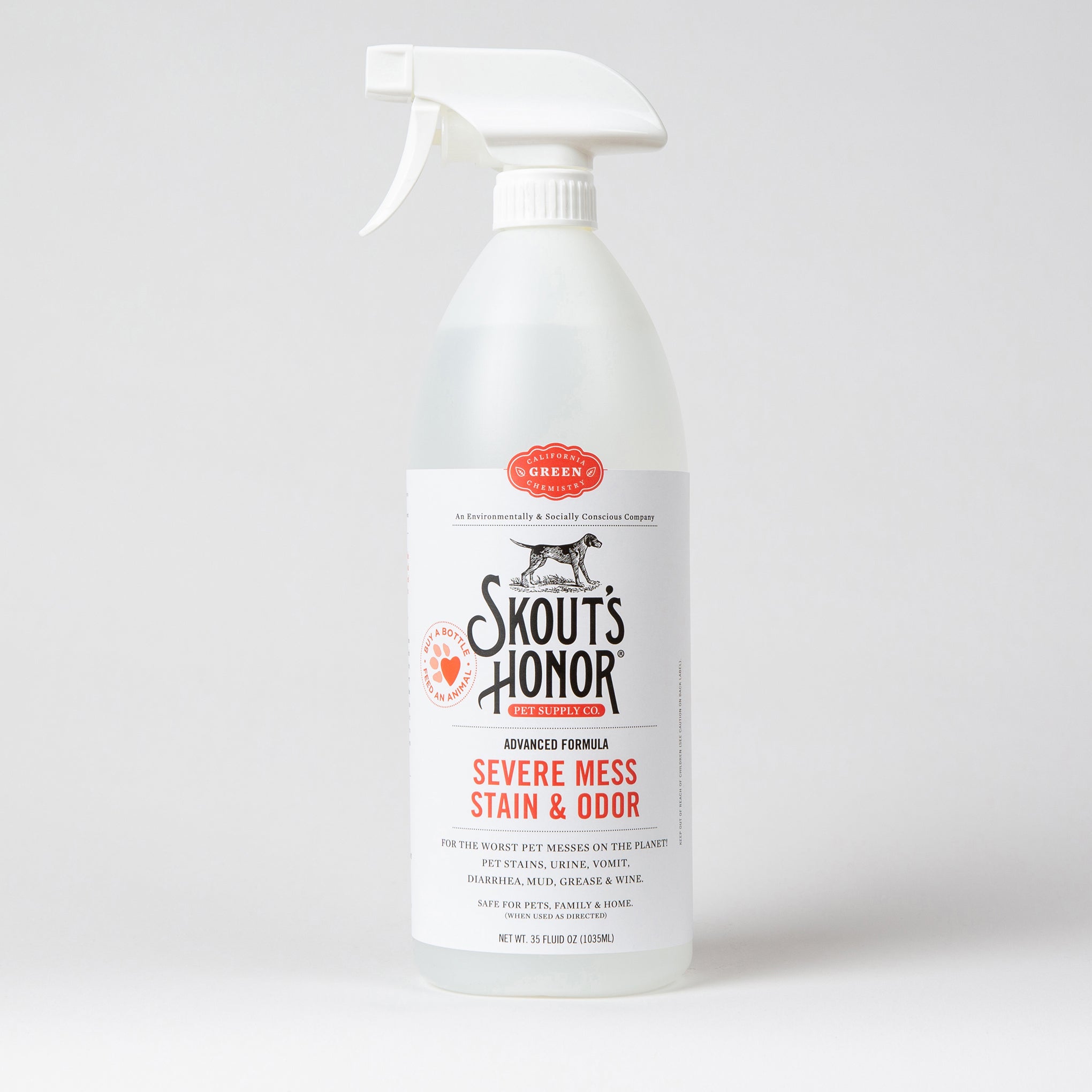
Vomit. Two problems at once: the acid and the pigment. Get it up quickly, because stomach acid can affect some dyes and finishes if it sits. Bile leaves a yellow cast that's often more stubborn than the original mess. Stain & Odor Remover handles it, and for a large or set-in one reach for Severe Mess Stain & Odor Advanced Formula instead.
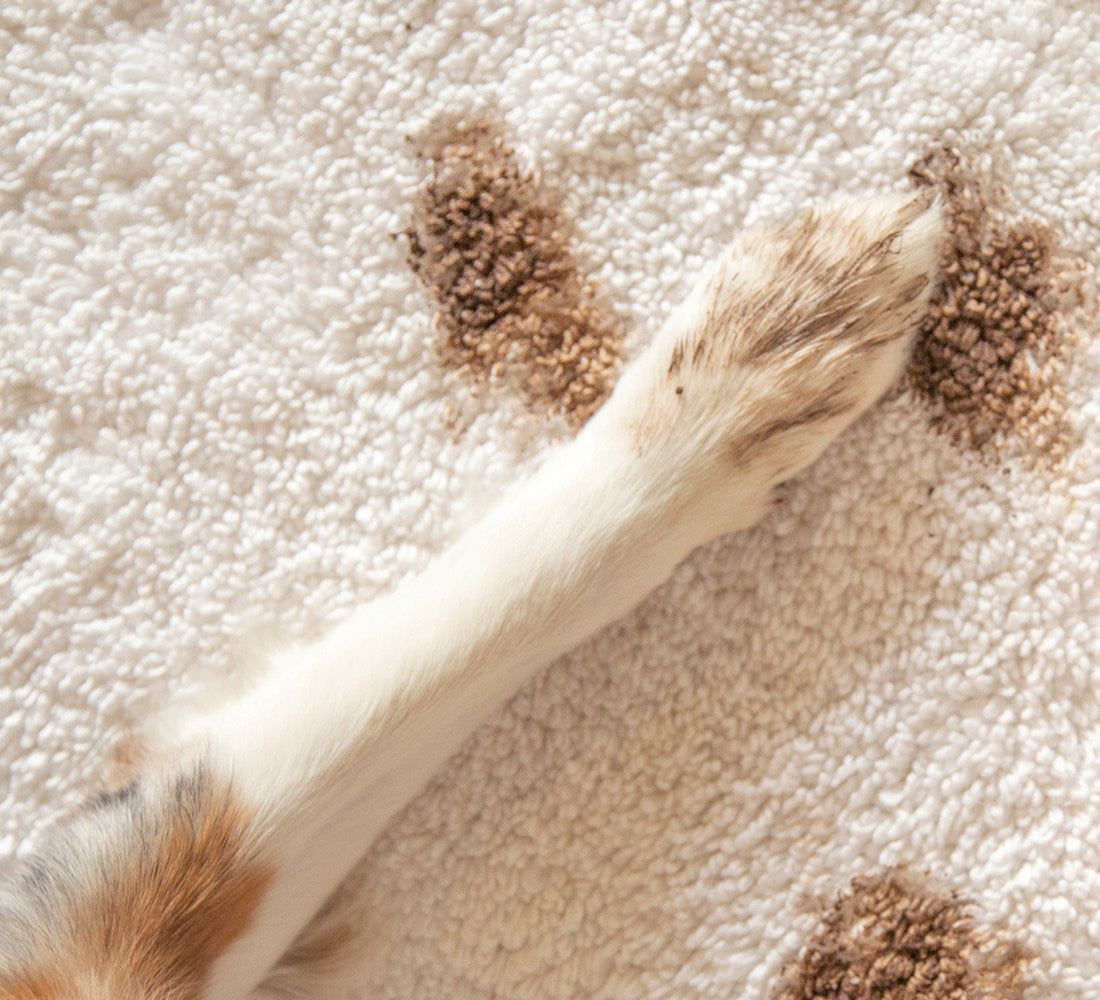
Mud. On carpet and fabric, let it dry completely first. Wet mud smears and drives further in, while dry mud vacuums out. Get the loose material up, then treat what's left. On a hard floor there's no need to wait. Worth noting that a yard can be entirely dry except for one patch, and that patch will be found, and the route back inside will pass over the lightest rug you own.
Blood. First, work out where it came from and whether your pet needs looking at. Then cold water only, and act fast, because heat sets blood almost immediately. Blot, treat, blot again, and repeat rather than going harder on a single pass.
Grease. From paws, from a dropped dinner, from whatever your dog rolled in. Lift off what you can while it's dry first, then treat. Grease needs a surfactant, which is exactly what Bio-Kore® is, so Stain & Odor Remover is the right call.
Wine and other spills. Not a pet mess, but our products work to clean it just as well. Same formula, same approach.
Skunk. A completely different problem that deserves its own product. A skunk can spray about ten feet, so a curious dog does not need to get close. The compounds are sulfur-based and extremely persistent, and as the Bristol chemistry above explains, part of what's in the spray converts back into the smelly version with water, which is why the old peroxide-and-baking-soda remedies so often seem to work and then don't. Those remedies can also bleach a coat. Skunk Odor Eliminator neutralizes it on contact and can be used on the pet as well as fabrics, furniture and outdoor areas. Follow the label directions for on-animal use, and keep it away from the eyes, nose and mouth. Skunks aim for the face, so if your dog took a direct hit there, flush the eyes with plain water or saline and call your vet. If you're in the middle of it right now, what to do when your dog gets skunked is the faster read.
What should you use on carpet, hardwood, tile and turf?
The technologies are the same across the range. What changes is how much liquid the surface can take and how you get it back out.
| Surface | How much liquid | How to finish | Watch out for |
|---|---|---|---|
| Carpet and rugs | Saturate, plus a wide perimeter | Wet/dry vacuum, several passes | The spot underneath is wider than the one on top |
| Upholstery and mattresses | Lighter than carpet | Blot and air dry fully | Test an inconspicuous spot first. Never re-cover a damp mattress |
| Hardwood (sealed) | Minimal | Treat and wipe | Unsealed or worn wood needs specialty care |
| Tile and sealed hard surfaces | As needed | Treat, wipe, dry | Grout is porous and holds odor after the tile looks clean |
| Laminate | As little as possible | Dry immediately | Liquid in the seams swells the core permanently |
| Concrete, pavers and artificial turf | Generous. Use a hose-end applicator | Let it soak and drain | Hosing alone does almost nothing on porous outdoor surfaces |
| Laundry | Normal wash volume | Cool to warm wash, air dry if any smell remains | Dryer heat sets whatever odor is left |
| Wool, leather, silk, unsealed wood | Skip entirely | Specialty care only | These need specific compatible treatments |
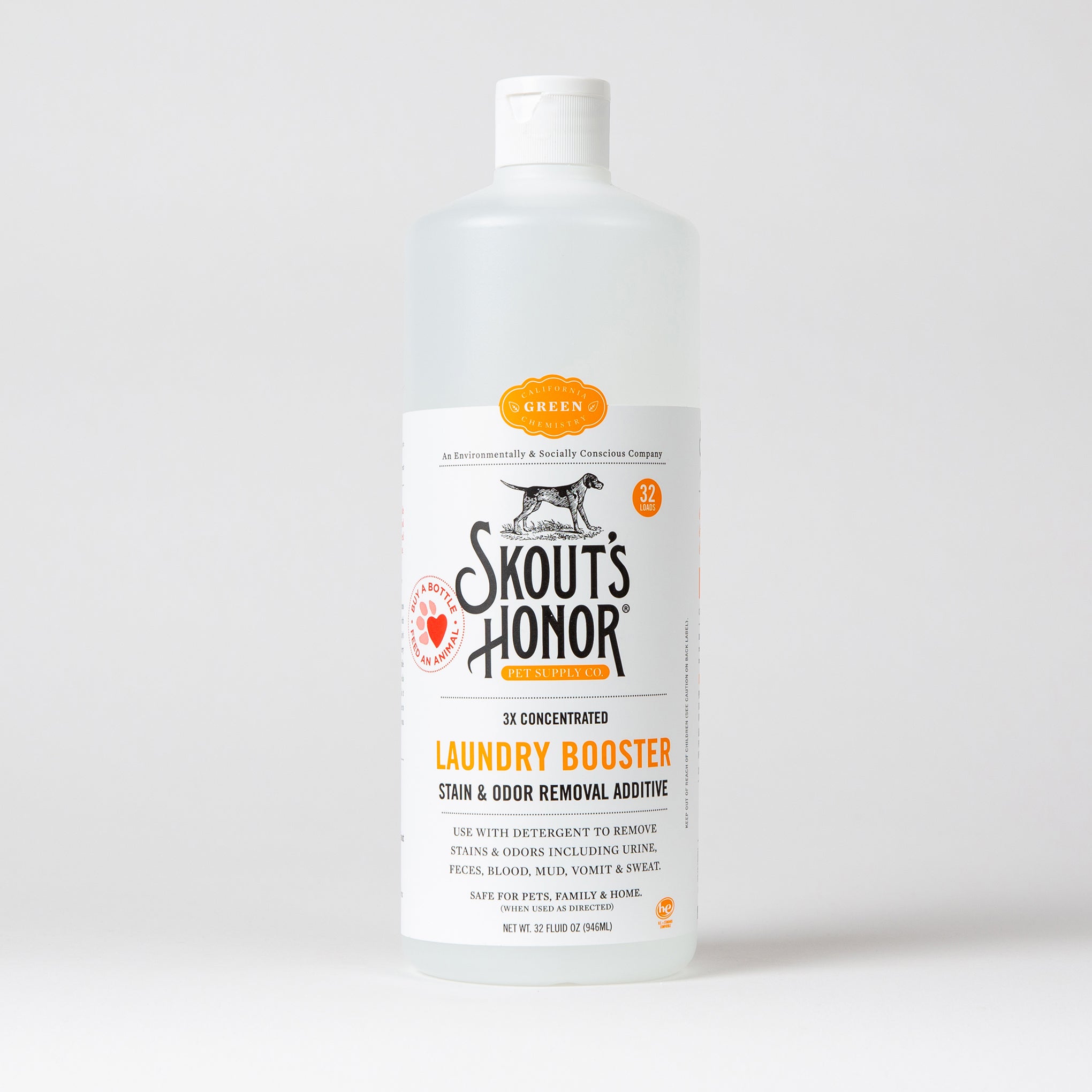
A few of those deserve more than a row. For old carpet spots, our saturate and extract walkthrough has the full method, and there's a separate walkthrough for dog pee on hardwood because the rules genuinely differ. Outdoors, Urine & Odor Destroyer for Concrete & Turf attaches to a hose and covers a wide area, which is what a dog run needs. For laundry, add Laundry Booster to your regular detergent. It's HE-compatible and works in any water temperature, which matters here, because the Iowa State heat rule applies inside a washing machine exactly as it does on a carpet. And for the air itself, the couch cushions, the car seats and the crate, Odor Eliminator is the one.
What are the exact steps to remove a dog stain and odor?
Four steps for a fresh mess, four slightly different ones for a mess that has dried in. The difference is extraction.
A fresh mess:
- Remove solids or blot up liquid, pressing straight down. Rubbing spreads it and pushes it deeper.
- Saturate the spot and a generous perimeter with the right formula for the mess.
- Give it about five minutes.
- Blot up the excess and let it air dry. Blotting is enough here because a fresh mess hasn't reached the padding yet. Extraction is for anything that has.
A mess that's dried in:
- Saturate the stain and a wide perimeter, following the directions on the bottle.
- Re-saturate the same area with plain water. Genuinely wet, not damp. The water gives the loosened material a way out.
- Go over it with a wet/dry vacuum, several passes, until the liquid is back out of the surface.
- Let it dry naturally, then reassess. A second pass on an old spot is normal, not a failure.
A UV black light is a cheap and genuinely useful buy if you're dealing with urine, since dried residue fluoresces and you can finally see what you've been missing. Fair warning: do not do your first lap of the house with the lights off unless you're ready for the results. Everybody thinks they have two spots. Nobody has two spots.
How do you stop the next accident from becoming a stain?
Keep the bottle within reach and treat the source, not just the surface. A mess treated in two minutes is a completely different job than one treated next week.
- Potty training. Accidents come with the territory. Keep the bottle somewhere you can grab it one-handed, because you will be doing this one-handed.
- Repeat spots. Habits attach to places, and getting the odor out at the source is the part you control. If it's an outdoor spot, the Concrete & Turf formula is built for it.
- Senior dogs. Washable bedding and a waterproof mattress protector will save you real money. Laundry Booster for the bedding, Odor Eliminator for the couch and the car.
When is it a repair or a vet visit instead of a cleaning job?
Two limits worth knowing before you spend another Saturday on this.
Sometimes it's a repair, not a clean. If liquid has gone through carpet and its backing into the padding, or down into a subfloor, no surface treatment reaches it. Any product claiming otherwise is overselling. The signs:
- The smell is strong at floor level but faint when you're standing up.
- The odor returns within days of a thorough job.
- The black light patch is far bigger than the original accident.
At that point the pad needs to come up.
Sometimes it's a vet visit. A house-trained dog who starts having accidents is worth a phone call rather than another bottle. Veterinary behaviorists Ellen Lindell (VMD, DACVB), Debra Horwitz (DVM, DACVB) and Gary Landsberg (DVM, DACVB, DECAWBM) write for VCA Animal Hospitals that "if your dog is house soiling, particularly if the behavior has started suddenly, it is important to ask your veterinarian to check for a physical illness," and they name urinary tract infections, kidney and liver disease, diabetes, Cushing's disease, intestinal parasites and age-related cognitive decline among the possibilities. A change in how much your dog is drinking, straining, or a smell coming from one specific place like ears, paws or mouth are all worth the same call. Cleaning solves a cleaning problem, and it's the easy half.
What are the key takeaways?
Treat the stain and the odor as two jobs, because they are. Saturate wider than you think you need to, extract rather than only blotting, and keep heat away from all of it. Match the formula to the mess, and be realistic when a spot has soaked somewhere a spray can't follow.
Everything mentioned here lives in our Stain & Odor collection.
And together, we feed an animal in need with every purchase. That's our Paw Pledge.
Frequently Asked Questions
Why does the smell come back when the stain is gone?
Because they're different materials. The stain is organic matter sitting in the fibers, and most cleaning removes it. The odor comes from a separate set of compounds, some of which barely dissolve in water and dry into a residue that grips the fibers. Until that residue is loosened and physically extracted, the smell keeps returning, usually on the first humid day.
How do I get dog stains out of carpet?
Saturate the stain and a generous perimeter rather than misting it, since liquid spreads out in a cone under the carpet. Wait a few minutes, then extract with a wet/dry vacuum rather than only blotting. Old spots often need a second pass, which is normal.
Do I need a different product for every kind of mess?
No. Stain & Odor Remover covers most of it, including feces, vomit, mud, blood, grease and wine. Urine is worth a dedicated formula because the odor compounds are more stubborn, Severe Mess is more concentrated for set-in stains, and skunk needs a separate product entirely.
What is the difference between masking an odor and eliminating it?
Masking puts a fragrance on top of a smell, so when the fragrance fades the original odor is still there. Eliminating means acting on the odor-causing compounds themselves. Our formulas are fragrance-free for exactly that reason.
Can I use a steam cleaner or hot water?
Better not to. Iowa State University Extension's AnswerLine notes that protein stains set when exposed to hot water, an iron or a dryer, because heat cooks the protein and causes it to coagulate between the fabric fibers. That applies to pet messes as much as to sports uniforms, and it is particularly bad on urine and blood. Use a room-temperature treatment and a wet/dry vacuum for extraction.
How long should I leave the product on?
About five minutes on a fresh mess. On a dried-in spot, follow the directions on the bottle, then re-saturate with plain water and extract. There's no long dwell time to manage, because nothing in the formula needs to activate first.
What surfaces should I avoid using it on?
Wool, leather, silk and unsealed wood all need specialty care. Carpet, rugs, upholstery, bedding, clothing and sealed hard surfaces are all fine. Go light on laminate, since liquid sitting in the seams can swell the core, and there's a dedicated formula for concrete and artificial turf.
Will it work on an old stain that's been there for months?
Often, but technique decides it. Saturate heavily, re-saturate with water, extract thoroughly, and expect to repeat. For severe or long-soaked messes, start with Severe Mess Stain & Odor Advanced Formula. If the padding underneath is holding the mess, that's a repair rather than a cleaning job.
Why does my dog smell like skunk again after a bath?
Skunk spray contains thioacetates as well as thiols. As the University of Bristol's Molecule of the Month explains, the thioacetates are less smelly, but water slowly breaks them down and releases the thiols again, so a dog can smell skunky days later after getting wet. That is why a remedy that seems to work can fail after the next bath or rainstorm, and why a product that neutralizes the compounds on contact is the better approach.
Is it safe around pets and kids?
Our stain and odor formulas are fragrance-free, biodegradable, made without harsh chemicals, and developed under California Green Chemistry Initiative standards. Safe for pets, family and home when used as directed. As with anything, let treated areas dry before pets are back on them.
Sources
- Simon Cotton, Butene thiol, Molecule of the Month, University of Bristol School of Chemistry, February 2022.
- Marlene Geiger, Dealing with Sport Stains, Iowa State University Extension and Outreach AnswerLine, May 14, 2024.
- Ellen Lindell VMD DACVB, Debra Horwitz DVM DACVB and Gary Landsberg DVM DACVB DECAWBM, Dog Behavior Problems: House Soiling, VCA Animal Hospitals.

The Most Common Cat Allergies
How to Stop A Dog From Chewing Everything in Sight