

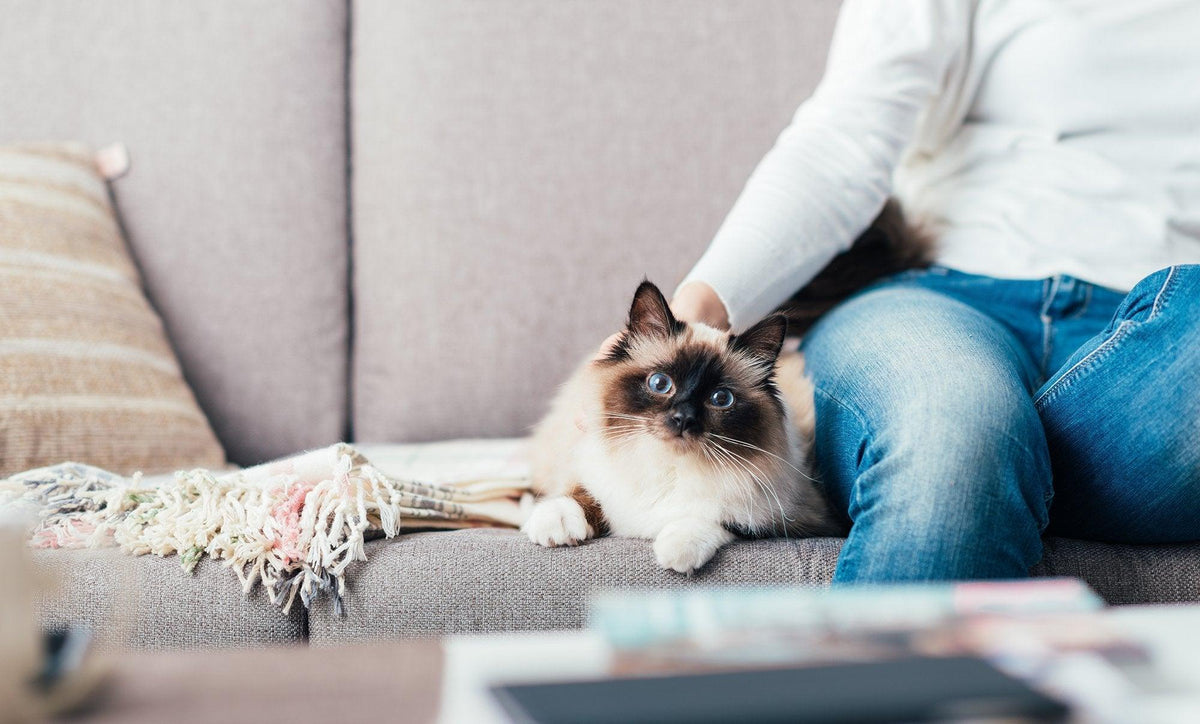
The short answer: A house that smells like cats almost always comes down to three things: the litter box, urine that has soaked into carpet or furniture, and fabrics that hold onto both. The simplest fix is the Skout's Honor Cat Essentials Bundle, which pairs Cat Urine & Odor Destroyer for accidents with Litter Box Deodorizer for the box itself. Add Laundry Booster for bedding and blankets, scoop at least once a day, and keep one box per cat plus one. If your cat starts going outside the box, call your vet before you change anything else.
Why does my house smell like cats?
Most cat smell starts at the litter box or in urine that lands somewhere porous, like a rug or couch cushion. Removing the source works better than covering it, which is why Skout's Honor Cat Essentials Bundle handles both the box and the accidents. Fragrance on top of urine doesn’t get rid of anything. It just gives you “Lavender Fields with Notes of Cat Pee.”
The usual sources, from most to least common:
- The litter box: waste left too long, too few boxes, or a box that needs a wash
- Urine on soft surfaces: carpet, padding and upholstery hold it
- Spraying: urine on walls, doors and furniture legs
- Fabrics: cat beds, throws and the clean laundry pile
- The cat: less common, but older or long-haired cats can use help
Reminder: It happens to all of us. You get used to the smell of your own house (pet smells and all), so trust your friend’s reaction when they walk through the door.
The numbers, from the Cornell Feline Health Center:
- House soiling is the most common behavior problem reported by cat owners
- 10% of neutered males and 5% of neutered females spray
- In homes with more than seven cats, it is likely that one or more will spray
How often should you change cat litter?
Scoop at least once a day, and wash the box with plain soap and hot water every one to four weeks, according to the AAFP and ISFM house-soiling guide. Between scoops, spray Skout's Honor Litter Box Deodorizer on used litter and into the air around the box. It uses a mineral-based molecular deodorizer to break down odors from urine, feces and pheromones, and leaves no residue.
Here is what the experts recommend:
| Task | How often or how much | Source |
|---|---|---|
| Scoop waste | At least once a day | AAFP/ISFM, Cornell, ASPCA |
| Replace all the litter | Weekly, or whenever it stops looking and smelling dry and clean | ASPCA, Cornell |
| Wash the box | Every 1 to 4 weeks with soap and hot water | AAFP/ISFM |
| Number of boxes | One per cat, plus one, in different spots | AAFP/ISFM, Cornell, ASPCA |
| Box size | 1.5 times your cat's length, nose to base of tail | AAFP/ISFM |
| Litter type and depth | Unscented, finer texture, about 1 to 2 inches deep | Cornell |
The AAFP/ISFM guide also recommends quiet, private spots away from busy areas. For more, see our tips to control litter box odor.
What neutralizes cat urine smell?
Cat urine smell has to be broken down at the source, not masked, because, as Cornell notes, a cat's nose picks up what a quick cover-up leaves behind. Skout's Honor Cat Urine & Odor Destroyer combines a plant-based cleaner with a mineral-based molecular deodorizer that breaks down odor molecules, and it works on old and new urine stains. There are no enzymes to activate, so it works on contact and never expires.
Use it on carpet, rugs, tile, laminate, upholstery, bedding and other water-safe surfaces, for urine, spray, vomit, feces and hairballs. Skip wool, leather and unsealed wood.
How to clean a cat urine spot:
- Blot up as much liquid as you can with paper towels. Press, do not rub.
- Spray Cat Urine & Odor Destroyer until the area is saturated, so it reaches as deep as the urine did.
- Let it sit, then blot or extract with a wet vac or absorbent cloth.
- Let it air dry. For stubborn or old stains, repeat.
- Do a sniff check the next day, up close.
What to avoid: the Cornell Feline Health Center says to skip cleaners containing ammonia or vinegar, since they smell like urine and can be irritating. The ASPCA adds that ammonia can draw a cat back to the same spot. For deeper carpet cleanup, read how to get cat urine out of carpet.
Does baking soda get rid of cat pee smell?
Baking soda can absorb some surface odor, but it does not reach urine that has soaked into carpet padding or cushions, so the smell usually comes back. For a fresh or old spot, Skout's Honor Cat Urine & Odor Destroyer is the better first move. Baking soda is still handy for washing the litter box, as the ASPCA notes. Skip vinegar and ammonia, which Cornell says smell like urine.
Why does my cat pee outside the litter box?
Peeing outside the box is often a medical issue, a stress response or a box setup problem, and a vet visit comes first. The AAFP and ISFM say every cat that starts house-soiling needs a physical exam and urinalysis. While you sort out the cause, clean every spot with Skout's Honor Cat Urine & Odor Destroyer so the smell is gone, not just faded.
Common reasons, per Cornell and the ASPCA:
- Medical: anything that affects normal urination, plus kidney disease, thyroid disease and diabetes
- Stress or territory: a new cat, a move, or a change in routine can lead to spraying
- The box itself: too few boxes, a dirty box, scented litter, or a box in a busy spot
How do I get cat smell out of clothes and bedding?
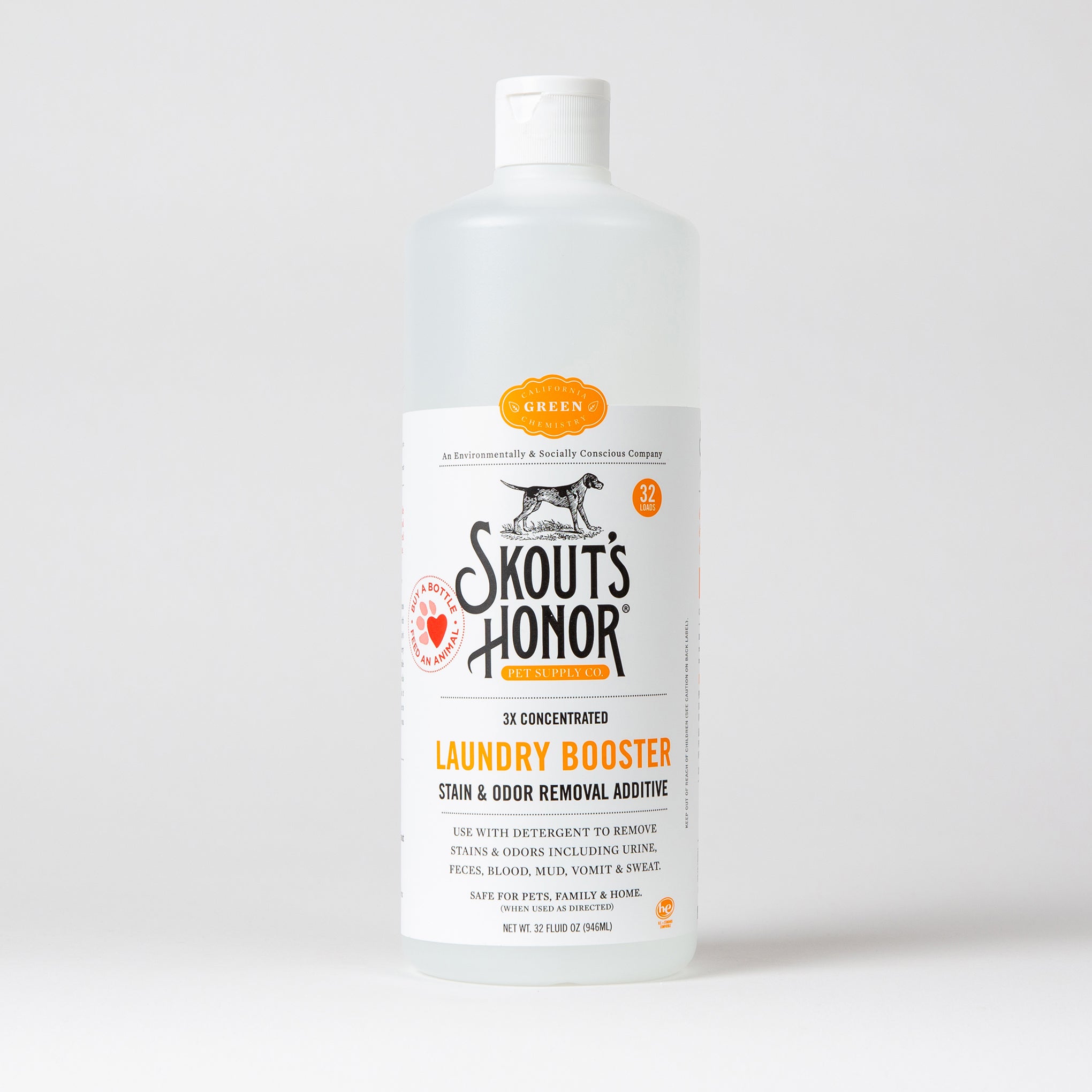
Wash cat-scented fabrics with Skout's Honor Laundry Booster alongside your regular detergent. Add 1 to 2 oz per load, in the bleach reservoir or straight into the basket on a top loader. It works in any water temperature, is compatible with HE washers, and each bottle covers up to 32 loads.
For a urine spot on clothing or a blanket:
- Saturate the spot with Laundry Booster and rub it in.
- Let it sit for five minutes.
- Wash as usual with your detergent and 1 to 2 oz of Laundry Booster.
- Air dry and give it a sniff before it goes in the dryer.
Use it on pet bedding, clothing, washable pee pads and other water-safe fabrics. Skip wool and leather.
How do I make my cat smell better?
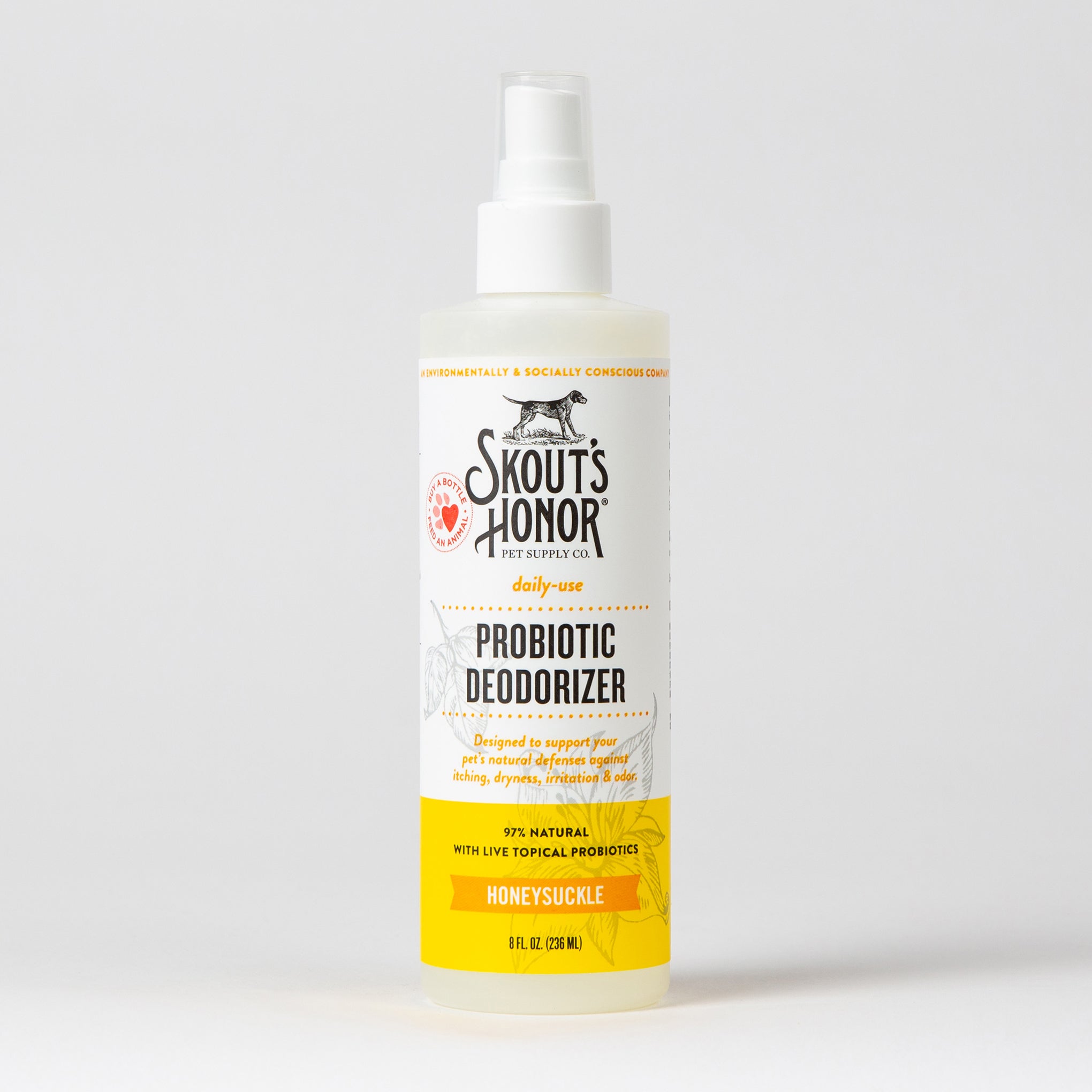
Most cats keep themselves clean, so a cat that smells is worth a quick look at the ears, teeth and coat, and a vet check if something seems off. For everyday freshness between baths, Skout's Honor Cat Probiotic Deodorizer (Honeysuckle) freshens and moisturizes the skin and coat with probiotics, avocado oil and aloe, and can be used daily. It is a good fit for cats who turn bath time into a two-person job.
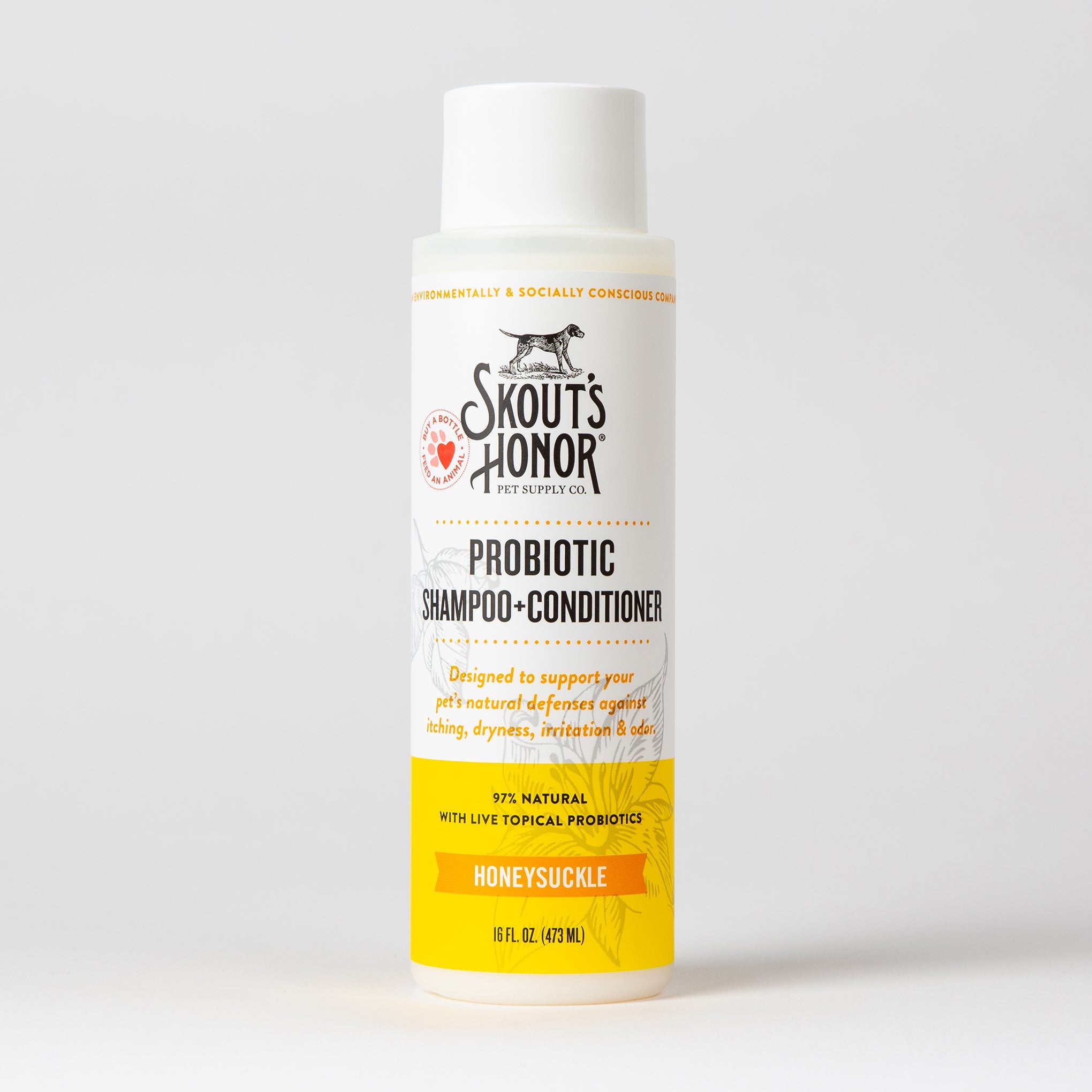
When a bath is due, Cat Probiotic Shampoo + Conditioner (Honeysuckle) gently cleans and moisturizes with probiotic kefir plus avocado, argan and coconut oils. Prefer no scent? There is a Fragrance Free version. Both are made for cats eight weeks and older. Our guide on how to bathe a cat walks through the process.
Brush regularly, especially long-haired and older cats, and call your vet about discharge, redness or a strong smell from ears, eyes or mouth.
Which Skout's Honor product do I need for cat smell?
Match the product to where the smell lives. Start with the Cat Essentials Bundle for the box and accidents, then add the rest as needed.
| Where the smell is | Product | How to use it |
|---|---|---|
| Litter box and the air around it | Litter Box Deodorizer | Spray on used litter and into the surrounding air |
| Urine, spray or vomit on carpet, rugs, upholstery | Cat Urine & Odor Destroyer | Saturate, let sit, blot or extract |
| Bedding, blankets, clothes | Laundry Booster | 1 to 2 oz per load with detergent |
| The cat, between baths | Cat Probiotic Deodorizer | Apply to coat, daily as needed |
| The cat, bath time | Cat Probiotic Shampoo + Conditioner | Back of the ears to the tail; cloth for the face |
How do I find where the cat smell is coming from?
Our take: most "whole house" cat smell comes from one or two spots you have stopped noticing, so find them before you buy anything else. Once you know the source, Skout's Honor Cat Urine & Odor Destroyer handles the spots and Litter Box Deodorizer handles the box.
The 10-minute sniff test you can run at home:
- Step outside for 10 minutes to reset your nose.
- Come back in and note which room hits first.
- In that room, check low and close: carpet corners, behind furniture, under beds, door frames and furniture legs (common spray spots).
- Scan with a UV flashlight in the dark. Dried urine spots may glow.
- Tape each spot, clean it, and re-sniff in two days.
If spots cluster near a window, door or new furniture, tell your vet. It can point to stress or territory.
FAQ
Is Cat Urine & Odor Destroyer an enzyme cleaner?
No. It uses a plant-based cleaner and a mineral-based molecular deodorizer, so there are no enzymes to activate and it is not affected by temperature. Read more about enzyme-free cleaners.
Does Cat Urine & Odor Destroyer disinfect?
No. It removes stains and odors but is not formulated to disinfect surfaces.
How many litter boxes do I need for two cats?
Three. The AAFP/ISFM, Cornell and ASPCA all recommend one box per cat plus one, placed in different spots.
Bottom line: Find the source, clean it properly, and keep the box on a schedule. Start with the Cat Essentials Bundle, add Laundry Booster for the blankets, and loop in your vet if the box habits change.
Sources
- Cornell Feline Health Center, Feline Behavior Problems: House Soiling
- American Association of Feline Practitioners and International Society of Feline Medicine, Feline House-Soiling: Useful Information for Cat Owners (2014)
- ASPCA, Litter Box Problems
What Is the Skin Microbiome? And Why Your Dog's Matters